
There has never been a moment in India's history when it has been so adrift in the world, so confused about what it stands for and against and so humiliated, asserts Aakar Patel.
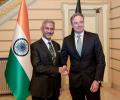
The era where nations thrived through rigid alignments is giving way to an age where the connective State defines power. For India, that era has arrived, points out Dr Nishakant Ojha.

Congress leader Rahul Gandhi launched a scathing attack on the BJP-RSS, labelling them a "bunch of jokers" with no understanding of India, and criticised Prime Minister Narendra Modi's foreign policy as merely "hugging leaders." He also claimed the RSS has become an instrument of large capital, serving Adani and Ambani, and vowed that the Congress would keep pressure on the government until Modi and Shah resign. The BJP hit back, calling Gandhi immature and out of depth.

Congress leader Rahul Gandhi on Friday accused External Affairs Minister S Jaishankar of "collapsing" India's foreign policy and questioned the government's handling of the recent tensions with Pakistan, particularly the US President Donald Trump's role as a mediator. Gandhi's remarks come amidst a war of words between the Congress and the ruling BJP over their leaders' statements on the Indo-Pak conflict.

Congress leader Rahul Gandhi has criticised Prime Minister Narendra Modi's foreign policy and his remarks referencing the COVID-19 pandemic in relation to the West Asia situation.

This might help explain why our global outreach has received such a tepid response. We have chosen to be transactional with the world, as our UN votes reveal, points out Aakar Patel.

Congress leader Rahul Gandhi has declared Indian democracy 'sacred' and dismissed the idea of boycotting elections, arguing it would dismantle the country's democratic framework. His remarks, made at the University of Chicago, came as the BJP intensified its criticism, accusing him of spreading anti-India propaganda by reiterating vote theft allegations on foreign soil. Gandhi also commented on India's foreign policy and the Israel-Gaza conflict.

The Delhi High Court has ruled that foreign nationals do not possess an inherent or legally enforceable right to enter India, even if they hold a valid visa. The court emphasised that entry is a sovereign function, subject to national security, foreign policy, and administrative discretion. This observation came while dismissing a plea from a Turkmenistan national who was denied entry despite having a business visa, citing adverse inputs and national security concerns.
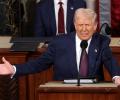
Experts suggest that a significant setback for US President Donald Trump in the midterm elections could compel him to pursue a swift trade agreement with India, as he seeks a quick foreign policy win amidst challenges with Russia, China, and Iran.
The BJP has strongly criticised Congress leader Rahul Gandhi for his comments on India's global standing and a Trump-Xi-Putin meeting, accusing him of being "clueless on geopolitics" and promoting "pro-Pakistan propaganda." BJP leaders highlighted India's strategic autonomy and engagement with various global forums, while questioning Gandhi's understanding of international diplomacy.

Bharatiya Janata Party on Thursday alleged the United Progressive Alliance government's credibility has gone down and internal politics of the alliance adversely affected India's foreign policy as evidenced by India's "failure" to sign a transit treaty with Bangladesh.

The Bharatiya Janata Party on Saturday attacked the government for not taking concrete steps in Sarabjit Singh's case, saying the attack on the Indian prisoner inside a Pakistani jail reflects the "total failure" of India's foreign policy.
The year 2011 saw various events -- the Arab Spring, anti- corruption protests, Europe's sovereign debt crisis -- transform countries and reshape the world order. Gateway House, a leading Mumbai-based think tank on India's foreign policy, takes a look at what these events mean for India, and presents India's top foreign policy cheers and jeers for the year.

'De-escalation was visible.'
The Finance Ministry has clarified that the decision to impose a 0.4% Merchant Discount Rate (MDR) on UPI transactions above Rs 2,000 was made independently, refuting claims of foreign influence. The ministry stated the policy aims to build a self-sustaining digital payments ecosystem, with MDR funding infrastructure and supporting small merchants.

In the first-ever separate resolution on foreign policy brought in its National Executive in Bengaluru, BJP attacked the previous Congress-led Government, saying "a cursory glance at the 'lost decade' of the UPA, reveals retreat and a loss of direction in engaging with neighbours, ham-handed diplomacy vis--vis Pakistan and a blind-spot in our foreign policy to the Indian Ocean island states."

'Foreign policy-making cannot be shifted out of Delhi and the regional satraps, who do not have a national perspective, should not be allowed to dominate foreign policy. But regional inputs should be integral to foreign policy-making at every step of the way,' says Ambassador T P Sreenivasan.

We should reassess what India's role in the world is and whether we are doing the right thing for ourselves, notes Aakar Patel.

Former US National Security Adviser John Bolton criticises JD Vance's attempt to distance himself from Donald Trump by blaming Republican midterm losses on the Iran war, calling it a "big political mistake". Bolton argues that broader voter dissatisfaction stemmed from economic issues, rising prices, and Trump's tariff policies, not just the Iran war. He also discusses Trump's leadership style, potential investigations, and the impact of US domestic turmoil on US-India relations.

'Once this entire AI and tech driven euphoria in the Western markets sees a correction there will be a re-evaluation of the Indian equity market and inflows will resume.'
If the decade gone by was one that redefined the contours of global politics in the aftermath of September 11, 2001, it was also a decade that witnessed Indian foreign policy coming into its own, writes Harsh V Pant

Former Bangladesh Prime Minister Sheikh Hasina has strongly criticised Prime Minister Tarique Rahman's decision to skip the BRICS summit in India, calling it "immature" and detrimental to Bangladesh's national interest. She argued that the absence lost opportunities for economic development and that foreign policy should not be driven by personal considerations. Hasina also highlighted the current "grave national crisis" in Bangladesh and her intention to return to restore democracy.

While remaining cautious of the unpredictability of a bruised Trump administration, New Delhi, and other world capitals, could go slow on the investment pledges made to stave off tariffs.
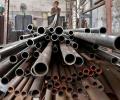
India's government is set to release its draft National Steel Policy for public consultation, aiming for over 600 million tonnes of steelmaking capacity and 500 million tonnes of consumption by 2047. The policy will also introduce a ~5,000-crore scheme to incentivise small steel producers for carbon emission reduction and address challenges like raw material availability and technological dependence.
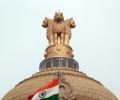
Delhi's inability to open up a new canvas with Pakistan and Sharif is symptomatic of its sluggish thinking. Jyoti Malhotra analyses

Foreign institutional investors have withdrawn nearly $40 billion from Indian equities in the last two years and, according to Bernstein analysts, have 'little reason' to invest for the long-term, though they may 'return to trade'. The brokerage highlights challenges such as struggling large-caps, disruption from new technologies, and difficulties accessing small- and mid-caps (SMIDs) at an institutional scale.

'What gives hope is that Modi's own leadership is vitally linked to his capacity to deliver on the economic front. Indeed, if he succeeds, India's foreign policies will have changed beyond recognition,' feels Ambassador M K Bhadrakumar.

India's Indo-Pacific approach has traditionally emphasised strategic autonomy, ASEAN centrality, freedom of navigation, respect for international law and an inclusive regional order. Its growing defence and maritime partnerships with Australia, Japan, Indonesia, Vietnam and other Southeast Asian countries provide additional depth to this approach, point out Dr Kumar and Dr Jasmeet Kaur.

When S Jaishankar became India's external affairs minister in May 2019, he was largely considered a political lightweight despite his undisputed mastery over foreign policy.

The Finance Ministry has dismissed allegations of US pressure influencing the 0.4% Merchant Discount Rate (MDR) on select UPI transactions. It clarified that NPCI guidelines prioritise RuPay credit cards on UPI and do not favour international cards. The ministry also asserted that the MDR, applicable to person-to-merchant transactions above Rs 2,000, is unlikely to increase cash transactions or cause inflation, with measures in place to prevent burdening consumers.

Japan's military will use Indian firing ranges for live-fire training, with drills scheduled to begin next year. The exercises will include surface-to-ship missiles for the first time, marking a significant expansion of bilateral defence cooperation.

Kazakhstan's decision to support foreign-born tennis players like Elena Rybakina and Alexander Bublik has been a successful investment, according to 26-year-old Zhebik Kulambayeva. Their success has significantly boosted tennis culture in the country, inspiring a new generation of players. Kulambayeva, currently competing at the Chennai Open, also shares her experiences on the professional circuit and her affinity for playing in India.

'Trump has weakened, not necessarily restrained.'

Prime Minister Narendra Modi has announced a significant 24,000 crore Nepalese rupees development package for Nepal, further solidifying bilateral ties and launching key India-assisted projects, including a new cross-border passenger rail link between Ayodhya and Janakpur Dham. This move signals a major reset in relations after a period of strain over border disputes, with both leaders emphasising deep kinship and mutual support.
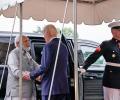
Foreign policy is always a work in progress and ups and downs are built into foreign policy process. What is permanent is national interest. Hopefully, this year, which will also witness general elections in the country, will also clear clouds in the foreign policy horizon, observes Rup Narayan Das.

Russian Foreign Minister Sergey Lavrov has publicly supported India's bid for a permanent seat on the United Nations Security Council. He stated that any reform of the UNSC should not grant additional seats to Western countries like Germany and Japan, citing their "militarism and revanchism." Instead, Russia advocates for increased representation from Asia, Africa, and Latin America, specifically backing India and Brazil, while also emphasizing the need to address African interests.

IndiGo is undertaking a comprehensive review of its long-standing policy against fuel hedging, particularly in light of rising jet fuel prices and its ambitious long-haul expansion plans. CEO Willie Walsh stated that while domestic competitors don't hedge, international expansion necessitates a re-evaluation to manage risk and provide stability against volatile fuel costs.

Morgan Stanley projects the BSE Sensex to reach 95,000 by December 2027, representing a 16 per cent upside, driven by an improving earnings cycle, relatively inexpensive valuations, and subdued foreign investor positioning.

The Indian government has indicated that Punjab Chief Minister Bhagwant Mann is unlikely to receive clearance to attend a conference in Lahore. The Ministry of External Affairs cited India's national policy towards Pakistan, particularly after the Pahalgam terror attack, as the reason for the probable denial. Mann was reportedly invited as chief guest to the International Punjabi Conference in Lahore from November 27 to 29.

India has banned the export of lithium-ion battery black mass with immediate effect to ensure domestic availability of critical minerals and strengthen its battery recycling industry. This move aims to address the underutilisation of domestic recycling capacity due to inadequate feedstock and reduce reliance on imports for essential minerals like lithium, cobalt, nickel, and manganese.
